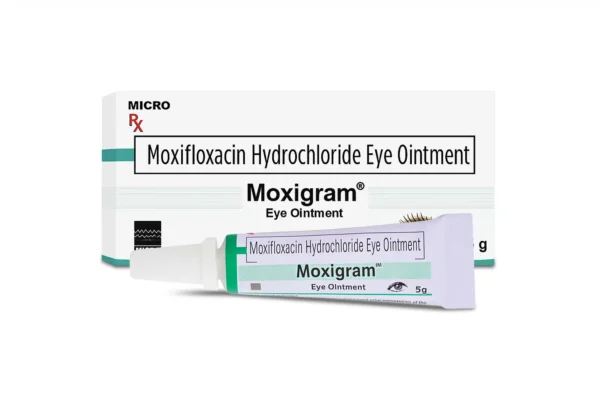
Moxigram Eye Ointment 5 Gm is a prescription-grade, broad-spectrum topical antibiotic ointment containing Moxifloxacin 0.5% — a fourth-generation fluoroquinolone antibiotic that represents the most clinically advanced generation of quinolone antibiotics used in ophthalmology today. Dispensed in a 5 gm tube for sustained treatment, this ointment is specifically formulated for direct application to the ocular surface to eliminate a wide spectrum of gram-positive and gram-negative bacteria responsible for common and serious bacterial eye infections. Unlike earlier-generation fluoroquinolones such as Ciprofloxacin and Ofloxacin, Moxifloxacin inhibits two bacterial enzymes simultaneously — DNA gyrase and Topoisomerase IV — making it significantly harder for bacteria to develop resistance and far more effective against resistant strains. The ointment formulation provides prolonged drug contact time with the ocular surface, making it particularly suited for bedtime application or use in patients who require extended antibiotic coverage. Order genuine Moxigram Eye Ointment from Ed Care Store — your trusted online pharmacy for authentic ophthalmic medications.Order Moxigram Eye Ointment 5 Gm → Buy Now at the Best Price
Composition — What Does Moxigram Eye Ointment Contain?
Each gram of Moxigram Eye Ointment contains the following active ingredient:
Moxifloxacin Hydrochloride (equivalent to Moxifloxacin 5 mg / 0.5% w/w): A fourth-generation fluoroquinolone antibiotic with the broadest bactericidal spectrum in its class. Moxifloxacin's unique molecular structure enables it to bind to and inhibit two critical bacterial enzymes — DNA gyrase (Topoisomerase II) and Topoisomerase IV — both of which are essential for bacterial DNA replication, transcription, repair, and recombination. Blocking both enzymes simultaneously means bacteria must develop two separate mutations to become resistant — an event so rare that Moxifloxacin demonstrates significantly lower resistance rates than its predecessors Ciprofloxacin, Ofloxacin, and Levofloxacin.
The ointment base is formulated without preservatives such as benzalkonium chloride — making it gentler on the ocular surface compared to preserved formulations — and provides a viscous, semi-occlusive film that extends drug contact time across the cornea and conjunctiva through the night.
What Is Moxigram Eye Ointment 5 Gm Used For?
Moxigram Eye Ointment is prescribed by ophthalmologists for bacterial eye infections caused by susceptible organisms. Its broad-spectrum coverage makes it effective across a wide range of clinical conditions:
Bacterial Conjunctivitis (Pink Eye): The most common indication. Moxifloxacin clears the bacterial pathogens — including Staphylococcus aureus, Streptococcus pneumoniae, Haemophilus influenzae, and Moraxella catarrhalis — responsible for the redness, purulent discharge, crusting, and eyelid swelling that characterise bacterial conjunctivitis.
Bacterial Keratitis (Corneal Ulcers): Moxifloxacin's superior corneal penetration and dual-enzyme inhibition make it a preferred choice for corneal ulcers — serious, sight-threatening infections of the corneal stroma. Its high tissue concentration at low doses ensures bactericidal activity against both susceptible and resistant strains.
Blepharitis: Chronic eyelid margin infection caused by Staphylococcal or other bacterial overgrowth. The ointment's prolonged contact with the eyelid margin during sleep makes it especially effective for this condition.
Post-Surgical Prophylaxis: Widely used before and after eye surgeries — including cataract surgery, LASIK, and corneal grafting — to prevent sight-threatening post-operative endophthalmitis and wound infections.
Pre-Operative Antisepsis: Applied in the days preceding ocular surgery to reduce the bacterial load on the ocular surface and periocular skin, significantly lowering infection risk at the surgical site.
Dacryo-Cystitis and Lid Infections: Lacrimal sac infections and secondary eyelid infections caused by susceptible bacterial organisms.
Important: Moxigram Eye Ointment is effective ONLY against bacterial infections. It will not treat viral conjunctivitis (caused by adenovirus), fungal eye infections, or herpes simplex keratitis — and using an antibiotic for non-bacterial infections can accelerate resistance. Explore our full range of eye care products for antibiotic, antiviral, steroid, and lubricant options.
How Does Moxigram Eye Ointment Work?
Moxifloxacin exerts its bactericidal effect through a dual-target mechanism unique among ophthalmic antibiotics. DNA gyrase is responsible for introducing negative supercoils into bacterial DNA — a process essential for DNA replication. Topoisomerase IV is responsible for separating daughter chromosomes following DNA replication, enabling cell division. Moxifloxacin binds simultaneously to both enzyme-DNA complexes, preventing the DNA strand from being re-ligated after cutting. The result is irreversible DNA fragmentation and rapid bacterial cell death — not merely growth inhibition. Because two separate enzymes must both mutate for resistance to develop, Moxifloxacin is highly active against strains already resistant to Ciprofloxacin, Gentamicin, and Tobramycin. As an ointment, it forms a sustained-release depot across the ocular surface, maintaining therapeutic drug concentrations throughout the night — producing up to 12 hours of continuous bactericidal activity from a single bedtime application. For daytime management of the same infection, consider pairing with Moxifloxacin Eye Drops to maintain around-the-clock coverage across the entire treatment course.
Dosage — How Much Moxigram Eye Ointment to Use?
For Bacterial Conjunctivitis (Adults & Children Over 1 Year)
Apply a small ribbon of ointment (approximately 0.5 cm) inside the lower eyelid of the affected eye(s) 3 times daily (every 8 hours) for 5–7 days. Continue the full course even if symptoms improve after 2–3 days — stopping early allows surviving bacteria to repopulate and may cause resistant re-infection.
For Corneal Ulcers and Severe Infections
Frequency may be increased to every 4–6 hours in the first 48 hours for severe keratitis or corneal ulcers, then tapered to 3 times daily as the infection responds. Always follow your ophthalmologist's specific prescription for severe ocular infections — self-adjustment is not recommended.
Post-Surgical Use
Typically 3 times daily for 5–7 days post-operatively, or as directed by your surgeon. Pre-operative use is usually started 1–3 days before the scheduled procedure. If you are also using antibiotic-steroid combination ointment post-surgery, consider Ocupol DX Eye Ointment (Chloramphenicol + Polymyxin B + Dexamethasone) for combined antibiotic and anti-inflammatory cover — consult your doctor for the most appropriate formulation.
How to Apply Moxigram Eye Ointment Correctly — Step-by-Step
Proper application technique ensures the antibiotic reaches the infection site and delivers maximum therapeutic effect throughout the treatment period:
Step 1 — Wash Hands: Wash your hands thoroughly with soap and water before and after every application. This is critical to prevent introducing additional bacteria to an already infected eye.
Step 2 — Prepare: Remove any eye discharge by gently wiping the closed eyelid from the inner to outer corner with a clean, damp cloth — using a fresh cloth for each eye to prevent cross-contamination.
Step 3 — Tilt Back: Tilt your head back and look upward toward the ceiling.
Step 4 — Pull Down Lid: Gently pull down your lower eyelid with a clean fingertip to create a small conjunctival pocket between the eyelid and the eyeball.
Step 5 — Apply: Hold the ointment tube close to (but not touching) the eye. Squeeze a small ribbon — approximately 0.5 cm — of ointment into the pocket. Do NOT allow the tube tip to contact the eye, lashes, or fingers, as this contaminates the tube.
Step 6 — Close & Spread: Close your eye gently and roll the eyeball in all directions to spread the ointment evenly across the ocular surface. Keep the eye closed for 1–2 minutes.
Step 7 — Wipe Excess: Gently wipe away any excess ointment from the eyelid margin with a clean tissue.
Step 8 — Replace Cap: Replace and tighten the tube cap immediately after use. Do not leave the tube open between doses.
Step 9 — Blurred Vision: Expect temporary blurring of vision for 5–10 minutes following application — this is normal. Avoid driving or operating machinery immediately after use.
For a first-timer's visual guide, read our blog: How to Apply Eye Ointment Correctly — with step-by-step instructions and hygiene tips for safe self-administration.
Common Side Effects of Moxigram Eye Ointment
Moxifloxacin is well-tolerated at the ocular level. Most side effects are local, mild, and resolve on their own as treatment progresses:
Temporary blurred vision — immediately after application; resolves within minutes
Mild burning or stinging sensation — brief discomfort at the application site
Eye itching or irritation — usually transient
Dry eyes — occurs in some patients, particularly with extended use
Watery eyes (lacrimation) — a common reflexive response to any foreign substance
Eye redness or conjunctival hyperaemia — mild and self-limiting
Photophobia (light sensitivity) — especially with corneal infections; resolves as the infection clears
Eyelid discomfort or swelling — uncommon; monitor and report if it worsens
Seek immediate medical attention if you experience:
Severe allergic reaction: intense rash, hives, facial or throat swelling, difficulty breathing, or anaphylaxis — discontinue immediately and seek emergency care.
Worsening symptoms: increased pain, discharge, or deteriorating vision after 48 hours of treatment — the infection may require a different antibiotic or a combined antibiotic-steroid preparation.
Secondary fungal infection: unusual discharge, white patches in or around the eye, or prolonged irritation — associated with prolonged antibiotic use.
Vision changes: sudden decrease in visual acuity, new floaters, or flashing lights — seek urgent ophthalmological review.
Precautions and Warnings Before Using Moxigram Eye Ointment
Inform your ophthalmologist before starting Moxigram Eye Ointment if you:
Are allergic to Moxifloxacin, any other fluoroquinolone antibiotic (Ciprofloxacin, Levofloxacin, Ofloxacin, Norfloxacin), or any component of the ointment
Have a known or suspected viral, fungal, or mycobacterial eye infection — do not use this ointment for non-bacterial infections
Have a history of herpes simplex keratitis or active herpetic eye disease
Are planning or have recently undergone eye surgery
Are pregnant or breastfeeding — use only if clearly necessary and prescribed by your doctor; safety has not been fully established
Are using contact lenses — remove lenses before application and do not reinsert until the infection has fully resolved
Have a history of prolonged antibiotic use to the eye — extended use may cause secondary fungal infections or resistant bacterial overgrowth
Contact Lens Warning: Never wear contact lenses while treating an active bacterial eye infection. Contact lenses — particularly soft lenses — harbour bacteria on their surface and within the lens matrix, actively re-introducing pathogens to the treated eye and preventing the infection from clearing. Resume lens wear only when your ophthalmologist confirms the infection has resolved completely.Children: Safety and efficacy of Moxifloxacin ophthalmic ointment in children under 1 year of age have not been established. Use in children aged 1 year and above is considered acceptable under direct medical supervision.Antibiotic Resistance Reminder: Complete the full prescribed treatment course even if symptoms improve after 2–3 days. Stopping early leaves residual bacteria alive, which can develop resistance to Moxifloxacin — converting a straightforward infection into one that is far harder to treat.
Moxigram Eye Ointment vs Other Antibiotic Ointments — What Sets It Apart?
Moxifloxacin is a fourth-generation fluoroquinolone — the most advanced generation currently available for ophthalmic use. Compared to second-generation agents like Ciprofloxacin or third-generation Levofloxacin, Moxifloxacin offers broader coverage against gram-positive pathogens — especially quinolone-resistant Staphylococci and Streptococci — that have become increasingly prevalent in community eye infections. Its preservative-free formulation reduces ocular surface toxicity compared to many preserved ophthalmic antibiotics. For infections that also involve significant conjunctival or corneal inflammation (redness, swelling, photophobia), a combined antibiotic-steroid formulation may be more appropriate — browse our full eye drops and ointments collection for antibiotic-only, steroid-only, and combination products across all leading brands. For a straightforward antibiotic-only eye drop for daytime use alongside this ointment, the Ciprofloxacin Eye Drops are a widely prescribed and cost-effective option for daytime dosing.
How to Store Moxigram Eye Ointment 5 Gm
Store between 10°C and 25°C (or below 30°C) in a cool, dry place away from direct sunlight, heat sources, and high humidity.
Do not refrigerate or freeze — temperature extremes affect ointment consistency and drug stability.
Keep the tube cap tightly closed after every application to prevent contamination of the tube tip.
Do not use ointment that has changed colour, texture, or smell — discard and replace.
Discard the tube after completing the prescribed treatment course — do not retain for future use, as the tube may become contaminated.
Keep out of reach of children and pets.
Check the expiry date printed on the tube and outer box — never use after expiry.
Understanding Bacterial Eye Infections — What You Should Know
Bacterial eye infections are among the most frequently misdiagnosed ocular conditions — often confused with allergic conjunctivitis, viral pink eye, or dry eye syndrome. Choosing the right treatment depends on correctly identifying the type of infection. Read these evidence-based resources from the Ed Care Store health library:
Bacterial vs Viral Conjunctivitis: How to Tell the Difference and What to Do
Eye Infection vs Eye Allergy: Spot the Signs and Choose the Right Treatment
What Is Bacterial Conjunctivitis? Causes, Symptoms & Treatment Options Explained
Why Buy Moxigram Eye Ointment 5 Gm from Ed Care Store?
Patients across India and worldwide trust Ed Care Store for genuine, prescription-grade ophthalmic medications delivered swiftly and discreetly to their door. Here is why we are the preferred destination for eye care medications:
100% Genuine Product: Authentic Moxigram Eye Ointment sourced directly from licensed pharmaceutical distributors — no counterfeits, no compromises on quality.
Competitive Pricing: Best-value pricing on every tube, with additional savings on multi-tube orders.
Discreet & Secure Delivery: Orders dispatched in plain, tamper-evident packaging — your privacy protected at every step.
Complete Eye Care Range: Browse our full eye drops and ointments collection — antibiotic drops and ointments, lubricants, anti-allergy, steroid, and combination eye preparations from all trusted brands.
Fast Dispatch: Orders processed quickly with real-time delivery tracking available.
Trusted by Patients: Verified reviews, secure checkout, and dedicated customer support — available whenever you need us.
Don't let a bacterial eye infection go untreated. Order Moxigram Eye Ointment 5 Gm NowDisclaimer: The content on this page is for informational purposes only and does not constitute medical advice. Moxigram Eye Ointment is a prescription medication. Always consult a qualified ophthalmologist or healthcare professional before initiating, changing, or stopping any eye treatment. Not intended for use in viral, fungal, or parasitic ocular infections.
Specifications
Moxigram Eye Ointment 5 Gm
4 Tube, 8 Tube, 12 Tube
Frequently Asked Questions
We offer free standard shipping on all orders. Orders are processed within 1-2 business days and typically arrive within 5-7 business days.
We accept returns within 30 days of purchase. Items must be in original condition with tags attached.
Yes! All our products come with a comprehensive warranty against defects in materials or workmanship.
Moxigram Eye Ointment 5 Gm
$15.40 – $44.40Price range: $15.40 through $44.40
Address 5954 Old Cove Heath Rd Eupora, Mississippi(MS), 39744